
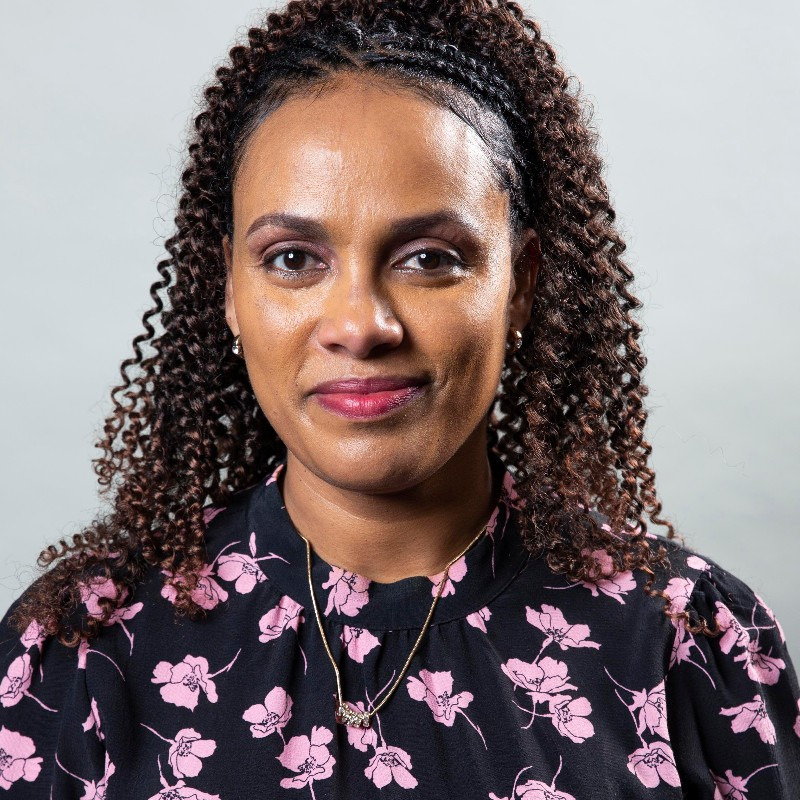
Amsalework Ejigu has a unique interdisciplinary background in Maths education, Epidemiology, and Climate Science, complemented by deep technical expertise in automated analysis, reproducible reporting, and transparent communication.
Starting with a Bachelor in Mathematics Education in Ethiopia, her early teaching experience instilled a commitment to clarity and accessibility, which became central to her data science approach. Seeking to apply quantitative methods to real-world outcomes, she earned an Postgraduate Diploma in Mathematical Sciences at AIMS further honed her problem-solving skills in a collaborative, pan-African environment.
A subsequent MSc in Epidemiology from Stellenbosch University, strengthening her statistical grounding and appreciation for data quality and uncertainty. She completed her academic training with a PhD in Climate Sciences from the University of Reading, focusing on fusion of climate models and data and developing robust analytical tools to analyse data and make it useful for decision-making.
Professionally, she has worked across Ethiopia, Ghana, and the UK in roles from mathematics educator to data analyst. This diverse experience has provided a grounded understanding of data use and the need for adaptable analytical tools. She takes challenges at diagnosing and resolving complex data issues, transforming messy inputs into clean, trustworthy outputs.
What’s the most interesting problem you’re working on right now?
I am currently working on a large‑scale data‑organisation challenge for climate stations. The core difficulty is that the metadata and the observations don’t live in the same place, and in many cases they don’t align. Stations appear under different names, units of measurements shift over time, and long historical records come with inconsistent recording, and structural changes that make automated processing far from straightforward.
The task is not simply to clean data; it is to design a system that can bring order to decades of decentralised information and make it usable for analysis, reporting, and decision‑making. It requires building tools that can reconcile mismatched metadata, detect structural irregularities, and create a unified, trustworthy dataset that can support automated reporting at scale.
When the pieces finally align and a previously unusable dataset becomes coherent, the impact is immediate: clearer insights, faster workflows, and a foundation that future teams can build on with confidence and partner organisations and farmers will benefit from the information which results from easy analysis of the data.
What’s most surprising, unexpected or rewarding about working in transdisciplinary collaborations?
Not surprising but one of the most rewarding aspects is seeing how automation can reshape the way a team works. Streamlining the reporting process doesn’t just make analyses faster – it frees people from repetitive tasks, reduces the risk of manual errors, and creates space for deeper thinking. When a workflow that once took days becomes a matter of minutes, the whole team feels the impact. It’s satisfying to know that the tools can simplify complex processes, save time, and allow collaborators to focus on the questions that matter most. My previous work streamlining the PICSA M&E survey data for reporting at the University of Reading has been invaluable here.
It’s humbling, too, to work alongside people whose knowledge pushes me to refine my assumptions and design systems that genuinely support their needs.
Why did you choose to work at IDEMS?
What began as a simple collaboration eventually shaped the entire direction of my career. I first met Roger while tutoring students at AIMS Ghana on MSc projects focused on statistical analysis of climate data. That collaboration grew naturally, and with Roger’s encouragement I applied to the University of Reading, where I went on to complete a PhD in Climate Science. What started as a short‑term academic interaction became a defining pathway for me, ultimately leading me to join IDEMS as an employee and continue the work that first inspired me.
Because the IDEMS approach sits at the intersection of technical rigour and real‑world impact. Climate data shapes decisions that affect communities, livelihoods, and long‑term planning. Building systems that make this data trustworthy, interpretable, and scalable feels meaningful. There’s also joy in the craft itself: solving stubborn bugs, refining pipelines, and watching a workflow evolve into something refined and dependable. The challenge is constant, and so is the growth.
I also appreciate the peace of mind that comes from the flexibility of working from home; it allows me to easily accommodate work around commitments like parents’ meetings and come back to work later in the day.
Where is home?
I am originally from Ethiopia, currently residing in Reading, where I am raising young children with my husband. This involves navigating the beautiful, yet complex, journey of parenting in a culture distinct from my own upbringing.
My life is defined by the meaningful challenge of balancing two worlds: honouring my roots while ensuring our children feel comfortable in their current environment. While I take joy in providing them with new opportunities and perspectives, there is a constant, quiet effort to preserve the traditions, and ways of life that shaped my childhood. Outside of work, I enjoy cooking often dishes that connect me back to home, watching documentaries about topics I had never encountered before, crafting with my daughter, and nurturing a new habit (swimming recently), which brings both calm and energy into my week.