No
Copies, Forks,
or Siloes.
One high-quality, expert-maintained impact program core.
Unlimited locally adapted and owned applications.
All connected and continuously evolving in a single living system.
Introducing
IDEMS
CommonTech
Middleware
now in prototype application and scaling
IDEMS CommonTech Middleware introduces the pioneering framework and software that lets otherwise incompatible systems work together. The innovation creates deep interoperability between one expert-developed open program (its resources, technology, and data) and unlimited custom, locally owned applications of that program, all within a single connected environment.
Each community’s local application has its own locally owned architecture, language, examples, tools, and data. Each application draws from and contributes back to the same expert-maintained core without needing to be built on the same assumptions.
This kind of interoperability wasn’t possible until now. It depends on breaking expert program resources into small, malleable data elements – all of which carry meaning in a single mathematical language. This has been mathematically possible for years, but too complex for humans to manage at real scale. Recent advances in AI make it manageable.
CommonTech’s expert, agentic AI organizes this complex but bounded data and expertise into reliable, trusted coherence. The data and expertise can come from experts and communities alike. The AI can work at a global scale while responding to one specific local need at a time.
This explainable AI supports human stakeholders. It surfaces relevant, provenanced data enabling people to make effective decisions. It also helps them efficiently develop and deploy high-quality program applications customized to deliver impact in their own communities, all without specialized program or technology expertise.

IDEMS CommonTech Middleware addresses a defining problem in creating sustainable impact at scale:
How can local stakeholders adapt, own, and improve expert social programming for their own communities, contributing local knowledge and data, without forking away from the high-quality, expert-maintained foundations they depend on?
CREATING A COLLABORATIVE, CONTINUOUS IMPACT IMPROVEMENT LOOP
A first-of-its-kind global
impact program operating environment
With existing technology, local impact program adaptations are standalone new applications that require costly, skilled development and upkeep.
IDEMS CommonTech Middleware brings unlimited local applications together in a single, living operating environment.
Real-world adaptations emerge from & local iterations automatically flow back through CommonTech, enabling ongoing program & tech R&D to update and strengthen the global expert core for improved impact — and dynamic upgrading of applications locally or worldwide without new investment.
IDEMS CommonTech Middleware
is powered by three complementary layers
LAYER 1:
INTEROPERABILITY IP
IP-protected interoperability framework & software

IDEMS Impact Brain
The Knowledge Library
Expert software and resources, structured as reusable data
LAYER 2:
Explainable AI
Safe, reliable, auditable,
resource-efficient AI


IDEMS AI Hands
The Expert Support
Narrow, bounded AI agents
support local program adaptation
LAYER 3:
SCALE ADAPTATION
Local innovation emerges from,
feeds back to a living system

IDEMS Impact Weaver
The Community Home
Non-technologist stakeholders
adapt and own local variants

LAYER 1:
INTEROPERABILITY IP
IP-protected interoperability framework & software
IDEMS Impact Brain
The Knowledge Library
Expert software and resources, structured as reusable data

LAYER 2:
AGENTIC AI
Safe, reliable, auditable, resource-efficient AI
IDEMS AI Hands
The Expert Support
Narrow, bounded AI agents enable programme adaptation

LAYER 3:
SCALE ADAPTATION
Local innovation emerges from, feeds back to a living system
IDEMS Impact Weaver
The Community Home
Non-technologist stakeholders adapt and own local variants
CommonTech maintains deep interoperability between an expert-maintained core and unlimited local adaptations in a single bounded impact operating environment
Expert-Maintained Resources Library
Continuously evolving core of expert-curated and maintained program software and resources
the library into
new variant data
IDEMS CommonTech Middleware
The Brain is the "under-the-hood" operations centre, holding Resource Library content as structured data in a novel deterministic core
AI Hands are the expert, auditable "go-betweens", making sense of the Brain's complex data for local adaptation – and of local application adaptation and innovation – for narrow use cases
The Weaver is the user-facing platform from which representative community stakeholders "weave" their own custom applications out of the Brain's data foundations, with the support of AI Hands
development of
sync with
Community-Owned Applications Variants
Unlimited local versions with custom architecture, functionality, language, examples and imagery. Local organisations control them without outside IT support, and all community data stays locally owned
{ now in prototype application and scaling }
Education
High-Quality
STEM Education
AI-enabled open educational resources (AI-OER) are in development or pilot in 14 countries to give low-resource educators and students access to high-quality teaching and learning resources.
Public health
Reducing Child Abuse
through Positive Parenting
The University of Oxford’s Global Parenting Initiative programming, proven to reduce sexual, physical abuse, is reaching 4.5M families in 21 countries.
agroecology
Participatory Research
Methods for Farmers
Digital tools and practices to improve food and economic security, part of the McKnight Foundation’s Collaborative Crop Research Program, are at work in 10 countries in Africa and South America.
climate
Climate Resilience for
Smallholder Farmers
Participatory Integrated Climate Services for Agriculture (PICSA), with the University of Reading, has trained nearly 1M farmers in 23 countries for a >75% increase in yields.
biodiversity
Bioeconomic Ecosystem
Resource Prediction
Able to predict species spread and/or loss under novel conditions as created by climate change, this proven innovation can save €48.9B/yr by preventing the spread of invasive species, preserving biodiversity.
And these are just the areas
IDEMS works in now.
What does CommonTech-enabled
adaptive scaling look like in practice?
Improving Parenting, Protecting Children
The University of Oxford Global Parenting Initiative (GPI) programming is proven to reduce child abuse and improve child outcomes. At $106/family it was too expensive and labor-intensive to scale offline.
Despite exploring options with technology platform partners and custom-built tech with UNICEF, GPI couldn’t scale programming across variable global contexts with existing tech. Programs only deliver impact by enabling, sharing ownership with:
- Local facilitators and parents,
who hold household context information, data & trust - Local NGOs & organizations,
which hold community knowledge, relationships & structures

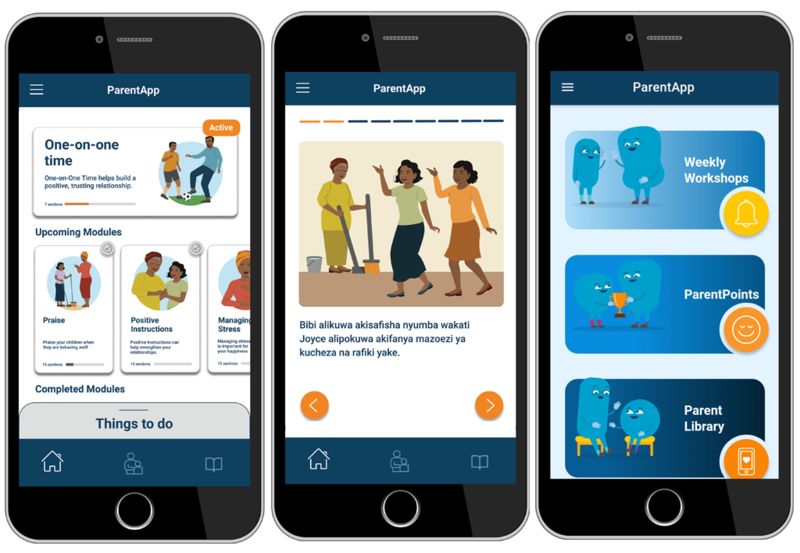
With GPI and its global NGO, Parenting for Lifelong Health, IDEMS built foundational adaptive digital programming (ParentText, ParentApp, FacilitatorApp, CrisisText) on prototype IDEMS CommonTech Middleware.
Adapted digital programme versions are now in 20+ countries, with nine new government-backed national rollouts planned by 2028.
“
I spend more time with my son now. I help him with his homework. I try hard to understand him more. I speak calmly to him and always try to find out his problem when he is agitated.
”
– Caregiver, Cameroon
40%
increase in parental engagement
67%
less sexual abuse of adolescent girls
45%
decrease in physical abuse of children
30%
decrease in caregiver stress and anxiety
$106
↓
$6
cost per family
And falling as adaptive scaling
expands into new countries & contexts
“
IDEMS is an outstanding example of real-world impact through partnership expertise
and endeavour – at the cutting edge of technology and on the frontlines of crisis.
”
– Professor Lucie Cluver
Professor of Child and Family Social Work,
Department of Social Policy and Intervention &
Advocate Lead, Global Parenting Initiative